
Guided toy finder
Find toys for the stage your little one is in right now
Pick your baby's age and the skill you want to spark. We'll show toys that match real developmental moments parents notice at home.
Start here
What should we help your baby practice?
Set the age, then pick a focus for today's play.
Slide to set your baby's age
-
Pull Toy – First Walking & Follow-Along Toy for Babies & Toddlers | Montessori Walking Toy | 8-36 Months
Vendor:Buy 2 Get 10% Off | Coupon: B2G10Regular price Rs. 429Regular priceUnit price perRs. 699Sale price Rs. 429Sale -
6-12 Months Baby Toy Box
Vendor:Buy 2 Get 10% Off | Coupon: B2G10Regular price Rs. 3,999Regular priceUnit price perRs. 4,349Sale price Rs. 3,999Sale -
BrainyTots Montessori Counting Peg Board Toy for Kids 1–3 Years | Early Learning Math Activity Set with 10 Wooden Number Board and Pegs , Storage Pouch & Play Guide for Toddler Brain Development
Vendor:Buy 2 Get 10% Off | Coupon: B2G10Regular price From Rs. 1,149Regular priceUnit price perRs. 1,599Sale price From Rs. 1,149Sale -
Sensory Texture Mat – Touch & Feel Discovery Play Mat
Vendor:Buy 2 Get 10% Off | Coupon: B2G10Regular price Rs. 899Regular priceUnit price perRs. 1,449Sale price Rs. 899Sale -
Wooden Counting Abacus with Addition Board | 1-10 Number Learning Toy | Builds Early Math & Fine Motor Skills | 3-6 Years | Montessori-Inspired, Non-Toxic Wood Toy for Joyful Learning
Vendor:Buy 2 Get 10% Off | Coupon: B2G10Regular price Rs. 839Regular priceUnit price perRs. 1,007Sale price Rs. 839Sale -
4 Shapes Wooden Puzzle - Montessori Shape Sorting Toy for Babies (6-24 Months)
Vendor:Buy 2 Get 10% Off | Coupon: B2G10Regular price Rs. 669Regular priceUnit price perRs. 999Sale price Rs. 669Sale -
Montessori Geometric Rainbow Blocks – Shape & Balance Building Set for toddlers
Vendor:Buy 2 Get 10% Off | Coupon: B2G10Regular price Rs. 609Regular priceUnit price perRs. 731Sale price Rs. 609Sale -
Object Permanence Box – “Where Did It Go?” Learning Toy
Vendor:Buy 2 Get 10% Off | Coupon: B2G10Regular price Rs. 1,639Regular priceUnit price perRs. 1,999Sale price Rs. 1,639Sale -
Wooden Shape Color Sorting Clock,Teaching Time | Number Blocks Clock Shape Patterns Sorting Puzzle | Montessori Early Learning Educational Toy | Gift for Kids 2-6 years
Vendor:Buy 2 Get 10% Off | Coupon: B2G10Regular price Rs. 439Regular priceUnit price perRs. 527Sale price Rs. 439Sale -
Ring Stacker – Size & Order Learning (Montessori Inspired)
Vendor:Buy 2 Get 10% Off | Coupon: B2G10Regular price Rs. 679Regular priceUnit price perRs. 949Sale price Rs. 679Sale -
Montessori Balancing Wobbler – Tummy Time Movement Toy for Babies 0-12 Months
Vendor:Buy 2 Get 10% Off | Coupon: B2G10Regular price Rs. 369Regular priceUnit price perRs. 599Sale price Rs. 369Sale -
Montessori Problem-Solving Kit For Toddlers- Wooden Learning Toys for 1-5 Year Olds
Vendor:Buy 2 Get 10% Off | Coupon: B2G10Regular price Rs. 1,499Regular priceUnit price perRs. 2,222Sale price Rs. 1,499Sale -
Montessori Nesting Bowls - Stacking Toys for Babies 6-36 Months
Vendor:Buy 2 Get 10% Off | Coupon: B2G10Regular price Rs. 769Regular priceUnit price perRs. 949Sale price Rs. 769Sale -
Montessori Rolling Drum Rattle – Grasp & Movement Toy for Babies
Vendor:Buy 2 Get 10% Off | Coupon: B2G10Regular price Rs. 369Regular priceUnit price perRs. 649Sale price Rs. 369Sale -
Montessori Egg Shakers – First Sound & Grasp Toy | Sensory Toy 0-18 Months
Vendor:Buy 2 Get 10% Off | Coupon: B2G10Regular price Rs. 499Regular priceUnit price perRs. 699Sale price Rs. 499Sale -
BrainyTots Wooden Shape Sorting & Stacking Board - Montessori Geometric Shape Sorter & Color Stacker Toy for Toddlers 1.5-4 Years, Learn Shapes, Colors & Counting 1-5, 20 Pcs, 5 Shapes, Boys & Girls
Vendor:BrainyTotsRegular price Rs. 499Regular priceUnit price perRs. 599Sale price Rs. 499Sale -
Montessori High-Contrast Cloth Book – Early Seeing & Calm Play Book for Newborns 0-12 Months
Vendor:Buy 2 Get 10% Off | Coupon: B2G10Regular price Rs. 259Regular priceUnit price perRs. 899Sale price Rs. 259Sale -

Montessori Egg & Cup Puzzle – First Balance and Placing Toy - Wooden Toy for Babies 6-15 Months
Vendor:Buy 2 Get 10% Off | Coupon: B2G10Regular price Rs. 419Regular priceUnit price perRs. 649Sale price Rs. 419Sale -
 Sale
Sale1.5-2 Years Toy Box
Vendor:Buy 2 Get 10% Off | Coupon: B2G10Regular price Rs. 3,799Regular priceUnit price perRs. 4,999Sale price Rs. 3,799Sale -
Faces Match Fun Cubes - Emotion Matching Cubes – Feelings & Face-Building Game
Vendor:Buy 2 Get 10% Off | Coupon: B2G10Regular price Rs. 399Regular priceUnit price perRs. 444Sale price Rs. 399Sale -
 Sale
Sale1-1.5 Years Toy Box
Vendor:Buy 2 Get 10% Off | Coupon: B2G10Regular price Rs. 3,999Regular priceUnit price perRs. 4,999Sale price Rs. 3,999Sale -
Brainy Thinking Worksheets — a 100-page screen-free, printable activity pack that builds the four early-thinking skills every preschooler needs before formal school: observe, compare, count, and focus.
Vendor:Buy 2 Get 10% Off | Coupon: B2G10Regular price Rs. 199Regular priceUnit price perRs. 499Sale price Rs. 199Sale -
Montessori High-Contrast Flashcards – Early Color & Focus Cards
Vendor:Buy 2 Get 10% Off | Coupon: B2G10Regular price Rs. 359Regular priceUnit price perRs. 399Sale price Rs. 359Sale -
BrainyTots Montessori Wooden Vehicle Tray Puzzle for Toddlers – 12 Vehicles
Vendor:Buy 2 Get 10% Off | Coupon: B2G10Regular price Rs. 499Regular priceUnit price per -
BrainyTots Wooden Sea Adventure Learning 3D Puzzle – 5-in-1 Montessori Activity Board for Kids 2-5 Years
Vendor:Buy 2 Get 10% Off | Coupon: B2G10Regular price Rs. 599Regular priceUnit price per -
0-6 Months Baby Montessori Toy Box
Vendor:Buy 2 Get 10% Off | Coupon: B2G10Regular price Rs. 3,999Regular priceUnit price perRs. 4,999Sale price Rs. 3,999Sale -

BrainyTots Preschool Prep Combo for Kids 3-7 – Wooden Spelling Game + Counting Frame Abacus (1–10)
Vendor:Buy 2 Get 10% Off | Coupon: B2G10Regular price Rs. 1,430Regular priceUnit price perRs. 1,699Sale price Rs. 1,430Sale -
BrainyTots Montessori Wooden Food Tray Puzzle – 12 Real Foods
Vendor:Buy 2 Get 10% Off | Coupon: B2G10Regular price Rs. 499Regular priceUnit price perRs. 599Sale price Rs. 499Sale -
Preschool Math & Letters Combo
Vendor:Buy 2 Get 10% Off | Coupon: B2G10Regular price Rs. 2,999Regular priceUnit price perRs. 3,999Sale price Rs. 2,999Sale





What brain development toys actually do (and where play does the work)
A toy is a prompt. The brain work happens when a baby reaches for it, drops it, gets it back and tries again. The early years are when the brain lays down connections fastest, and it does that through repetition: the same ball dropped into the same box thirty times. A good brain development toy gives the child one clear thing to figure out, sized for the hands they have this month, then gets out of the way. So everything here is simple: wood, cloth and card, one skill each. Your part: sit close, name what you see, and let the child do the doing.
Brain development toys for newborns (0 to 6 months)
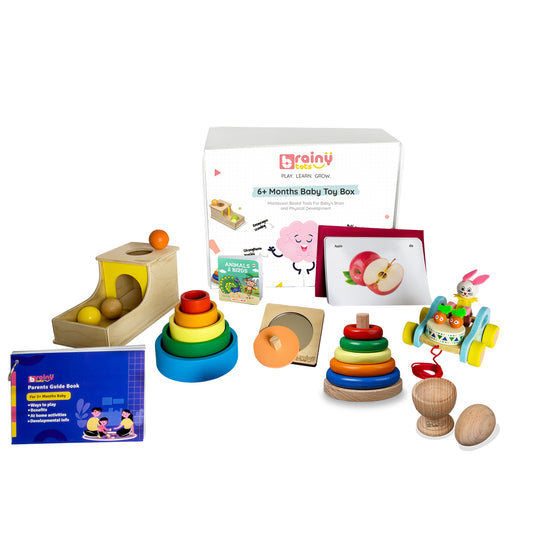
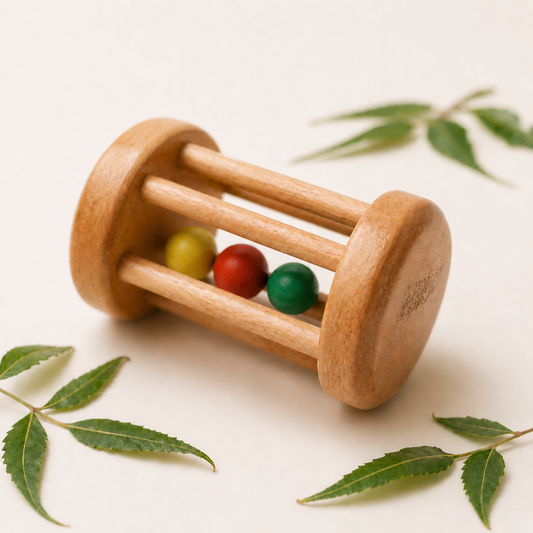
Infant brain development toys work on the two senses that are ready first: sight and touch. A newborn sees black and white before colour and focuses best at about 20 to 30 cm, so high contrast flashcards with a baby-safe mirror (16 double-sided cards) give the eyes something to hold onto during tummy time, and the high contrast jungle cloth book adds crinkle pages and a neem wood teether ring for the mouth. From 2 to 3 months the balancing wobbler rocks when a hand bumps it, the first lesson in cause and effect, and the rolling drum rattle rolls away and answers with sound, which is what gets a baby to push up and reach. Educational toys for a newborn are this short list, used daily: see newborn baby toys 0 to 6 months, or the 0 to 6 months baby toy box with its month-by-month guidebook.
Brain development toys for a 6 month old to 12 months
6 month baby toys for brain development are about hands and the big idea of the year: things still exist when they disappear. The object permanence box is that idea made of wood. A ball goes in the hole, vanishes, rolls out into the tray, and around 8 or 9 months the baby starts to expect it; that expectation is memory being built. The ring stacker, five graded rings on a short dowel, is the first size and order toy, and nesting bowls in five sizes teach which fits inside which. The 4 shapes knob puzzle and egg and cup puzzle train the finger grip that comes before a pencil, and the sensory texture mat adds seven textures for tummy, back and sitting play. Browse baby toys for 6 to 12 months or take the 6 to 12 months baby toy box with its parents' guidebook.
Toys for brain development 1 to 2 years
1 year baby toys for brain development should give a walking, pointing toddler a job to finish. The numbers peg board is our first pick for the year: ten wooden number boards, each with holes to match, and pegs to push in one at a time. Counting starts in the fingers long before it is said out loud, and every peg builds the pincer grip. The pull toy teaches that pulling a string makes something follow, which sends a new walker across the room and back, and the shape sorting and stacking board puts five shapes, colours and counting to five in twenty pieces. The 1 to 1.5 years toy box and 1.5 to 2 years toy box cover each half of the year; more at toys for 1 year olds.
Brain development toys for 2 to 3 year olds
At two the brain is sorting the world into categories and the mouth is catching up with words. Loose-pack tray puzzles do both jobs: the food tray puzzle and the vehicle tray puzzle each hold twelve chunky pieces to name, sort and pack back in, twelve new words and a tidy-up game in one. Geometric rainbow blocks, ten sizes, are for building, balancing and knocking down, the physics lesson every 2 year old runs on repeat. The Toddler Problem-Solving Kit pairs the peg board with the rainbow blocks, and the Sea Adventure 5-in-1 board starts as an eight-animal puzzle with a 1 to 10 number row and flips to an alphabet and tracing board that lasts to five. See toys for 2 year olds.
Brain development toys for 3 to 6 year olds
From three the brain wants systems: numbers that add, letters that make words, faces that mean feelings, time that moves. The wooden counting abacus has 100 beads in five colours and a printed addition board, so counting turns into first sums a child can see. The sorting clock is four toys in one: numbers 1 to 12 as removable blocks, twelve shapes, colours to match and hands for telling time. Faces Match Fun Cubes, four expression cubes and 16 challenge cards, give a preschooler the words for happy, sad and upset, and the Brainy Thinking Worksheets, a 100-page printable pack, train observe, compare, count and focus with a pencil. The Preschool Prep Combo pairs the spelling game with the abacus; the Preschool Maths and Letters Combo adds the peg board and sorting clock. More at toys for 3 year olds and learning toys for 4 to 6 year olds.
How to choose the right brain development toys by age
Choose by what the child is practising this month, and hold one rule per age.
0 to 3 months: contrast over colour. Black and white cards 20 to 30 cm from the face, moved slowly, for as long as the baby stays with them. Buy for the eyes; the hands come later.
3 to 6 months: things that answer back. A wobbler that rocks, a rattle that rolls and sounds, a mirror. One action, one result, every time, so the baby learns that their body makes things happen.
6 to 12 months: a hole, a lid or a slot. Object permanence box, ring stacker, egg and cup, a knob puzzle. In and out is the whole curriculum of this half year.
1 to 2 years: a job with an end. Ten pegs into ten holes, a pull toy across the room, five shapes into five slots. The child can see when they are done, which is where focus comes from.
2 to 3 years: pieces to name. Twelve foods, twelve vehicles, ten blocks, with a tray to pack them back into, so play ends with sorting and the words come from you while they hold each one.
3 to 6 years: one toy per system, and self-correcting. Numbers on the abacus, letters in a spelling game or tracing book, time and shapes on the sorting clock, feelings on the faces cubes. A piece fits one slot, a bead row adds up, so the child checks their own answer.
At every age, four to six toys within reach beats a full shelf; store the rest and rotate every two weeks. Read the age band on each product page, keep the smallest pieces for table play with a grown-up close, and follow the child's pace rather than the box.
Best brain development toys by age: 6 picks
- High contrast flashcards with mirror (0 to 6 months): 16 double-sided cards and a baby-safe mirror.
- Object permanence box (6 to 24 months): drop, vanish, reappear, the game that builds memory.
- Ring stacker (6 to 24 months): five graded rings, size and order by hand.
- Numbers peg board (1 to 5 years): ten boards and matching pegs, counting by touch.
- Geometric rainbow blocks (2 to 5 years): ten wooden shapes to stack, balance and knock down.
- Wooden counting abacus (3 to 6 years): 100 beads and an addition board, counting to first sums.
What are the best brain development toys for a 1 year old?
A numbers peg board, a pull toy, a shape sorting and stacking board and nesting bowls. Each gives a 1 year old a job with a visible end, which builds focus, and works the fingers that later hold a pencil.
Which toys help a 6 month old baby's brain development?
An object permanence box, a ring stacker, an egg and cup puzzle and a sensory texture mat. At 6 months the brain is learning that things exist out of sight and that hands make things happen, so a hole to drop into and a piece to pull out do the most work.
Are educational toys for infants worth it in the first year?
Yes, when they are simple. A newborn needs contrast to look at and something safe to grip and mouth; a 6 month old needs in and out. Two or three plain toys used daily, with you naming what happens, do more than a shelf of toys that play by themselves.
How many brain development toys does a child need?
Four to six out at a time, one per skill the child is working on, with the rest stored and swapped in every two weeks. A toy that comes back after a fortnight gets played with like a new one.
When should I start brain development toys for a newborn?
From the first weeks, with high contrast cards held 20 to 30 cm from the face for a minute or two at a time, then a cloth book or soft rattle from around 2 months when the hands start to open. The age band on each product page tells you when the rest belongs.
Shop by age: newborn baby toys 0 to 6 months · baby toys 6 to 12 months · toys for 1 year olds · toys for 2 year olds · toys for 3 year olds · learning toys for 4 to 6 year olds
Shop by type: baby teethers · play gym attachments · stackers and nesting toys · wooden puzzles · board books for babies · cloth books and touch and feel books · Indian story books for kids · books for babies and toddlers · toy boxes and Montessori kits · combos
Shop by skill: brain development toys by age · counting toys · reading, alphabet and phonics toys · senses and discovery · movement and motor skills · thinking and problem solving
Gifts by age: gifts for a newborn baby · gifts for a 6 month old baby · gifts for a 1 year old · gifts for a 2 year old · gifts for a 3 year old · gifts for a 4 year old · gifts for a 5 year old
Popular searches: brain development toys · toys for brain development 1 to 2 years · infant brain development toys · 6 month baby toys for brain development · 1 year baby toys for brain development · educational toys for infants · educational toys for newborn · brain development toys for 2 year olds · brain development toys for 3 year olds · object permanence box · montessori toys for babies · counting toys
Let customers speak for us

My twin just obsess with this hanging balls... please must buy for your born

My 13 month old points at the animals and tries to say their names now, and the thick pages survive her page turning.

Lost a few pegs under the sofa and my 3 year old kept noticing the empty holes. These fit the board perfectly and the colours match the original set.

Worth every rupee

Keeps her busy!

Great quality, baby loves stacking them!
Got this for my 7 month old and she figured out the grip within a day. The rattle sound inside is what really got her attention, she shakes it and then looks up at me every single time. Light enough that she can hold it on her own without help.

My 5 month old stretches up and bats at the hanging toys by herself now, and it buys me a good twenty minutes to get something done.

My 5 month old is teething and this is the only thing she actually keeps in her mouth. The discs are light enough that she can pass it from one hand to the other on her own, which she could not do a month ago. Easy to rinse and there is no smell to it.
My daughter is 6 months and right in the middle of teething, so these have been the easiest thing to just hand her. The discs are linked together so she passes them from one hand to the other, which she has only recently started doing. Easy to wash and no strange smell after boiling. Best part is she has stopped going for the TV remote quite so much.

My 14 month old pulls this around the entire house and it has really helped his balance while walking.

Bought this for my 3 month old and it is the one box I keep reaching for. The high contrast pieces hold her attention through tummy time and she has started swiping at the rattle on her own. Wood finish is smooth with no rough edges, feels sturdy for daily use.

My son was about 2 months old and would start fussing the moment I put him down anywhere. I wrapped this around the pram bar mostly hoping it would buy me ten minutes. He locked onto the spiral and just stared at it, kicking his legs, long enough for me to finish my tea. It is honestly the first thing he has ever properly focused on. Now we move it between the crib and the pram every single day.
Baby is hooked!

Bought this hoping it would help with letter recognition and it has done more than that. My 4 year old now sits and builds the three letter words on his own while I finish my calls. The blocks are chunky and smooth, and the cards are thick enough to survive a preschooler.