
Guided toy finder
Find toys for the stage your little one is in right now
Pick your baby's age and the skill you want to spark. We'll show toys that match real developmental moments parents notice at home.
Start here
What should we help your baby practice?
Set the age, then pick a focus for today's play.
Slide to set your baby's age
-
4 Shapes Wooden Puzzle - Montessori Shape Sorting Toy for Babies (6-24 Months)
Vendor:Buy 2 Get 10% Off | Coupon: B2G10Regular price Rs. 669Regular priceUnit price perRs. 999Sale price Rs. 669Sale -
Montessori Geometric Rainbow Blocks – Shape & Balance Building Set for toddlers
Vendor:Buy 2 Get 10% Off | Coupon: B2G10Regular price Rs. 609Regular priceUnit price perRs. 731Sale price Rs. 609Sale -
Montessori Problem Solving Kit For Babies - Montessori Wooden Toys Gift Set for 6-18 Months
Vendor:Buy 2 Get 10% Off | Coupon: B2G10Regular price From Rs. 2,739Regular priceUnit price perRs. 3,799Sale price From Rs. 2,739Sale -
Ring Stacker – Size & Order Learning (Montessori Inspired)
Vendor:Buy 2 Get 10% Off | Coupon: B2G10Regular price Rs. 679Regular priceUnit price perRs. 949Sale price Rs. 679Sale -
Montessori Nesting Bowls - Stacking Toys for Babies 6-36 Months
Vendor:Buy 2 Get 10% Off | Coupon: B2G10Regular price Rs. 769Regular priceUnit price perRs. 949Sale price Rs. 769Sale -
BrainyTots Wooden Shape Sorting & Stacking Board - Montessori Geometric Shape Sorter & Color Stacker Toy for Toddlers 1.5-4 Years, Learn Shapes, Colors & Counting 1-5, 20 Pcs, 5 Shapes, Boys & Girls
Vendor:BrainyTotsRegular price Rs. 499Regular priceUnit price perRs. 599Sale price Rs. 499Sale -

Montessori Egg & Cup Puzzle – First Balance and Placing Toy - Wooden Toy for Babies 6-15 Months
Vendor:Buy 2 Get 10% Off | Coupon: B2G10Regular price Rs. 419Regular priceUnit price perRs. 649Sale price Rs. 419Sale -
Wooden Shape Puzzle Set - Montessori Shape Sorting Toy for 1 Year Old
Vendor:Buy 2 Get 10% Off | Coupon: B2G10Regular price Rs. 839Regular priceUnit price perRs. 1,007Sale price Rs. 839Sale -
Montessori Pincer Puzzle – Finger Grip & Shape Fitting Toy
Vendor:Buy 2 Get 10% Off | Coupon: B2G10Regular price Rs. 332Regular priceUnit price perRs. 399Sale price Rs. 332Sale


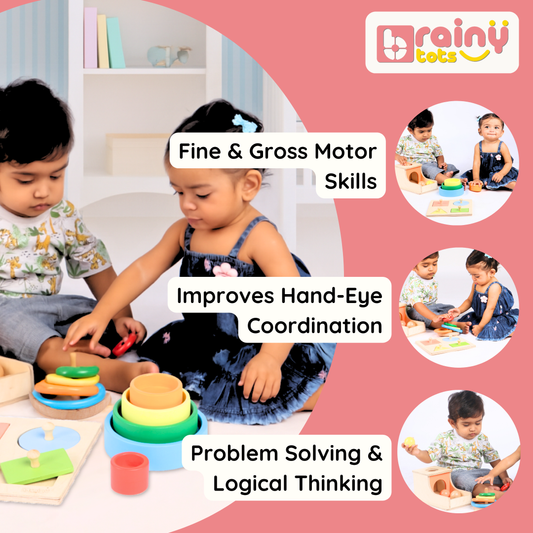


Ring stacker for babies: what stacking teaches at 6 to 24 months
Stacking looks simple and is anything but. To drop a ring onto a post a baby has to hold the ring, aim the hole at the post, let go at the right moment and watch what happens. Each of those is a separate skill arriving in a different month: the whole-hand grip at 6 months, the aim at around 9, the controlled release at 10 to 12, and the idea that big goes under small somewhere in the second year. A ring stacker holds all four on one post, which is why it is the one toy on almost every first-year list.
Nesting adds a second idea: inside. A bowl that fits inside another bowl teaches size order through the hands before the child has words for big and small, and the same five bowls flip over to become a tower, a set of drums or cups for a pretend kitchen. Blocks add a third idea, balance, and arrive last, because a toddler needs the steady release a stacker taught before a block will stay where it is put.
Stacking toys for babies: which one first, by month
6 to 9 months. The ring stacker, used the wrong way round. A sitting baby pulls every ring off, chews the biggest one and bangs two together. That is the whole game and it is enough. The pincer puzzle joins at around 9 months: one beech cylinder, one hole, and the thumb-and-finger grip a pencil will need years later.
9 to 12 months. Rings start going back on, in any order, and the nesting bowls come out. Stacked as a tower they fall, which is the point; nested they disappear one inside the other, which is the first object-permanence trick a baby can do alone.
12 to 18 months. Size order arrives. Rings go on biggest first more often than by chance, bowls nest in sequence after a few tries, and the shape puzzle set adds a second question, which slot, to the first, does it fit.
18 to 24 months. The sorting and stacking board and the rainbow blocks. Twenty pieces in five shapes sort onto pegs and stack in colour towers, and the blocks turn a stacker's straight tower into a balanced one that rebuilds into a cube one way. Past two, the same child moves on to wooden puzzles and the peg boards and early maths toys.
Ring stacker or nesting bowls: which to buy first
Buy the ring stacker first if your baby is under 9 months; it survives chewing and banging and gives a sitting baby something to do with both hands. Buy the nesting bowls first if your baby is already crawling and emptying cupboards, because bowls do everything a kitchen cupboard does, in baby-safe colours and sizes made for the job. Both stay in play until two, so the order matters less than starting. The problem solving kit for babies pairs the stacker with an object permanence box for families who want the set in one go.
How to choose wooden stacking toys (size, weight, finish, safety)
Rings with a wide hole and a rounded post go on with less frustration than tight ones, and a heavy base stays put when a baby leans on it. Bowls need a clear size step between each pair so they nest without wedging. Look for hardwood turned smooth, matte water-based paint on the colours and an oil rub on the natural wood, and check that every piece is bigger than a baby's fist. The ring stacker here is BIS approved and lathe-turned from solid Indian hardwood with a birch post; the pincer puzzle is beech with rounded edges. Wipe with a damp cloth and let it air-dry fully; that keeps the wood tight and the paint bright. Look each piece over before play and retire any piece that cracks.
5 ring stackers and nesting toys to buy now
- Ring stacker, 6 to 24 months: graded wooden rings in matte primary colours on a birch post with a solid base, gentle enough for teething gums, and the first "I did it" tower.
- Wooden nesting bowls, 6 to 36 months: five bowls in five sizes and colours that nest, stack, hide things and serve pretend tea, in play from six months to three years.
- Shape puzzle set, 4 to 24 months: a four-shape knobbed puzzle plus a circle puzzle with a mirror, the bridge from stacking to fitting.
- Shape sorting and stacking board, 1.5 to 4 years: 20 pieces in five shapes and colours to sort onto pegs, stack in towers and count to five.
- Geometric rainbow blocks, from 15 months: ten multi-sized wooden blocks that balance in towers and rebuild into a single cube, the step after the stacker.
Stacking toys as a first birthday gift
A ring stacker is the classic first-birthday gift because a one-year-old can use it that afternoon and still be using it at two. Pair it with the nesting bowls for a gift that covers the whole second year, or choose the problem solving kit for babies, which bundles the stacker, an object permanence box and a shape puzzle or nesting bowls in one box. Toddler cousins get the toddler problem solving kit, a numbers peg board and rainbow blocks together. More by age on the toys for 6 to 12 months and toys for 1 to 1.5 years pages.
Ring stacker and stacking toys FAQs
At what age can a baby use a ring stacker?
From 6 months for pulling rings off and chewing them, from about 9 months for putting them back, and from 12 to 18 months for stacking in size order. The stacker here is listed for 6 to 24 months.
Are wooden stacking toys safe to chew?
Yes, when the wood is dense hardwood, the paint is water-based and every piece is bigger than a fist. Stay close, wipe with a damp cloth, air-dry, and retire any piece that cracks.
Ring stacker or nesting bowls, which first?
Ring stacker under 9 months, nesting bowls once your baby is crawling and emptying cupboards. Both stay in play until two, so the order matters less than starting.
What comes after the ring stacker?
Nesting bowls, then the shape puzzle set, then the sorting and stacking board and the rainbow blocks, roughly one new piece every three to four months. After two, wooden puzzles and the numbers peg board take over.
Are these Montessori stacking toys?
They follow Montessori principles: one skill per toy, natural materials, and a design that shows the child the mistake without an adult stepping in. A ring that misses the post falls; a bowl that is too big sits on top instead of inside.
Shop by age: toys for 0 to 6 months · toys for 6 to 12 months · toys for 1 to 1.5 years · toys for 1.5 to 2 years · toys for 2 to 3 years · toys for 3 to 5 years. Shop by type: cradle toys and hanging toys · stacking toys and shape sorters · play gym attachments and hanging toys · baby teethers · wooden puzzles for kids · board books for babies · cloth and touch-and-feel books · Indian story books for kids · all books for babies and toddlers · senses and discovery toys · movement and motor skills toys · thinking and problem solving toys · language and reading toys · numbers, letters and early maths toys. Sets and gifts: Montessori toy boxes by age · toy combos. · Brain development toys by age · बच्चों के खिलौने.
Popular searches: ring stacker · wooden nesting bowls · stacking toys for 1 year old · shape sorter for 1 year old · pincer puzzle · wooden blocks for toddlers · problem solving toys for babies · wooden puzzles for 1 year old · toys for 6 month old baby · baby teethers · play gym attachments
Let customers speak for us

My twin just obsess with this hanging balls... please must buy for your born

My 13 month old points at the animals and tries to say their names now, and the thick pages survive her page turning.

Lost a few pegs under the sofa and my 3 year old kept noticing the empty holes. These fit the board perfectly and the colours match the original set.

Worth every rupee

Keeps her busy!

Great quality, baby loves stacking them!
Got this for my 7 month old and she figured out the grip within a day. The rattle sound inside is what really got her attention, she shakes it and then looks up at me every single time. Light enough that she can hold it on her own without help.

My 5 month old stretches up and bats at the hanging toys by herself now, and it buys me a good twenty minutes to get something done.

My 5 month old is teething and this is the only thing she actually keeps in her mouth. The discs are light enough that she can pass it from one hand to the other on her own, which she could not do a month ago. Easy to rinse and there is no smell to it.
My daughter is 6 months and right in the middle of teething, so these have been the easiest thing to just hand her. The discs are linked together so she passes them from one hand to the other, which she has only recently started doing. Easy to wash and no strange smell after boiling. Best part is she has stopped going for the TV remote quite so much.

My 14 month old pulls this around the entire house and it has really helped his balance while walking.

Bought this for my 3 month old and it is the one box I keep reaching for. The high contrast pieces hold her attention through tummy time and she has started swiping at the rattle on her own. Wood finish is smooth with no rough edges, feels sturdy for daily use.

My son was about 2 months old and would start fussing the moment I put him down anywhere. I wrapped this around the pram bar mostly hoping it would buy me ten minutes. He locked onto the spiral and just stared at it, kicking his legs, long enough for me to finish my tea. It is honestly the first thing he has ever properly focused on. Now we move it between the crib and the pram every single day.
Baby is hooked!

Bought this hoping it would help with letter recognition and it has done more than that. My 4 year old now sits and builds the three letter words on his own while I finish my calls. The blocks are chunky and smooth, and the cards are thick enough to survive a preschooler.