3–18 m

Montessori Teethers
₹449 ₹499 10% off
See what fits your little one →
Continue shoppingHave an account?
Log in to check out faster.

Discover special offers on BrainyTots Montessori toys, educational toys, books, and learning...

Shop by Type · Play gym & hanging toys
Neurosurgeon-reviewed. Designed by Nikita Aakhade, Harvard-certified in Early Childhood Development.
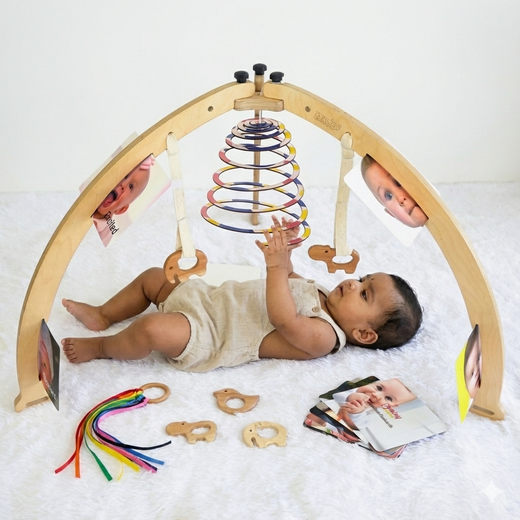
A baby play gym is a bar or arch that holds toys above a baby on their back or tummy. The attachments do the developmental work: a slow mobile to track at 0 to 3 months, hanging balls to bat and grasp at 3 to 6 months, then teethers and cards that become handheld toys from 6 to 12 months. Every piece here hangs from any gym, cot bar or rod you own.
5 toys & books★ 4.9 · 206 reviews (4.9 out of 5)
How old is your little one? We’ll mark what fits now — and what comes next.
5 toys & books
Nothing here for that combination — try fewer filters.
Free · one email per stage
Just before each new stage we’ll send the milestones to watch for, one play idea and the toys that help. No spam, unsubscribe any time.
The BrainyTots guide
In the first three months a baby's eyes are still learning to focus and to follow. Bold black and white shapes held close are the first things a newborn locks onto, and a slow-moving shape gives those eyes a reason to track from left to right. A play gym at this age is a looking gym: one mobile turning gently, a high-contrast card propped in view, a mirror for the first glimpse of a face.
From about three months the arms join in. A baby on their back starts swiping at whatever hangs above, and that swipe is the beginning of hand-eye coordination. A hanging ball that swings and clinks when hit teaches the loop that matters most this year: I moved, something happened, I can make it happen again. By five or six months the swipe becomes a grasp, grasped things go straight to the mouth, and teething usually starts, so the attachments a baby can pull down and chew earn their place.
Between six and twelve months the gym changes from somewhere to lie into a base for sitting, rolling and crawling. Balls hung a little higher stretch a sitting baby's reach; teethers and ribbons come off the bar and become handheld toys that pass from one hand to the other; the cards turn into peekaboo and pointing games. The same five attachments cover the whole year.
Start with two things: something to look at and something to follow. The spiral mobile is the follow toy; it turns slowly in still air and is dual-sided, a bold side for the first weeks and a coloured side for later. The high-contrast cards are the look toy, propped against the gym leg or at the edge of the mat so a newborn on their back or in short tummy-time bursts has a pattern within 20 to 30 cm. Add the mirror from the same set once your baby holds their head up on their tummy, because a face, even their own, is the most interesting thing in the room.
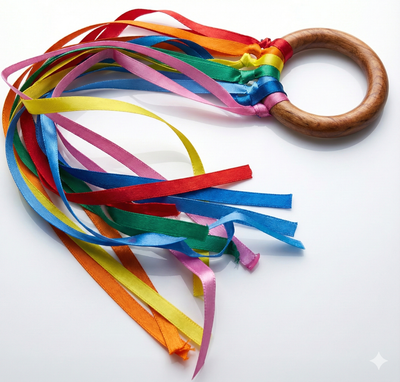
At three months hang the wooden balls so the lowest one sits where a stretched arm meets it and the highest is a stretch away. Your baby bats the low ball, hears the clink, watches it swing back and tries again; over the following weeks the reach climbs up the cord. Hang the rainbow ribbon teether beside it. Ribbons are the easiest thing for a three-month-old fist to catch, and once caught they head for the mouth, which is exactly what sore gums want.
Parents searching for a play gym for a 1 year old usually already own one and want to know what is worth hanging on it now. A one-year-old uses the gym as a pull-up bar and the attachments as loose toys. Raise the hanging balls so a sitting or standing baby reaches up for them, and move the teethers, the ribbon ring and the cards to the floor basket. From here the next steps are stackers, nesting bowls and first puzzles, which have their own pages: ring stackers and nesting toys and wooden puzzles for kids.
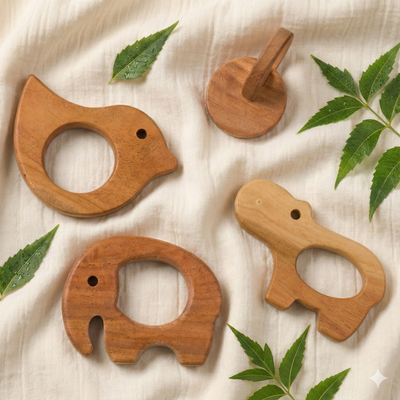
Height first: hang each toy so your baby can touch it with a stretch, and keep cords short so nothing loops near the face or neck. Check every knot and clip before each session, and stay within arm's reach whenever the gym is up. Size next: anything that goes in the mouth should be bigger than a baby's fist, which is what the wooden hanging balls are sized for. Material last: raw or oil-finished hardwood for anything chewed, water-based paint on anything coloured, cotton cord, and cards in thick board that wipe clean. Wooden pieces like a damp-cloth wipe and a full air-dry, and a monthly rub of food-safe coconut oil keeps neem wood mellow.
A play gym attachment is the newborn gift that gets used on day one and is still in the basket at the first birthday. The spiral mobile and the ribbon teether together make a small, light gift that travels well; the hanging balls are the pick when the family already owns a gym. For a bigger gift, the Montessori toy boxes group a whole stage's toys in one box, and the toys for 0 to 6 months page has the rest of the first-year list, including the baby teethers.
From the first weeks, for short sessions on the back with one slow mobile to watch. Add hanging toys to bat at around two to three months, and teethers once mouthing starts, usually around three months.
Yes. Each piece hangs by a cord or loop, so it ties onto a wooden gym, a cot bar, a pram hood or a rod. The hanging balls come with their own birch bar.
Dense, fine-grained hardwood with a raw or oil finish is the traditional teether in Indian homes, and the neem pieces here are BIS approved. Stay close during every session, wipe with a damp cloth, air-dry fully, and retire any piece that cracks.
The high-contrast cards and the mirror. Prop a card 20 to 30 cm in front of your baby's face and swap it when interest fades; the mirror is the reward for lifting the head.
The wooden gym frame is sold out at the moment. Every attachment here hangs from a cot bar, a pram hood or any gym you already own, and the toys for 0 to 6 months page has the full first-year list.
My twin just obsess with this hanging balls... please must buy for your born
My 13 month old points at the animals and tries to say their names now, and the thick pages survive her page turning.
Lost a few pegs under the sofa and my 3 year old kept noticing the empty holes. These fit the board perfectly and the colours match the original set.
Worth every rupee
Keeps her busy!
Great quality, baby loves stacking them!
Got this for my 7 month old and she figured out the grip within a day. The rattle sound inside is what really got her attention, she shakes it and then looks up at me every single time. Light enough that she can hold it on her own without help.
My 5 month old stretches up and bats at the hanging toys by herself now, and it buys me a good twenty minutes to get something done.
My 5 month old is teething and this is the only thing she actually keeps in her mouth. The discs are light enough that she can pass it from one hand to the other on her own, which she could not do a month ago. Easy to rinse and there is no smell to it.
My daughter is 6 months and right in the middle of teething, so these have been the easiest thing to just hand her. The discs are linked together so she passes them from one hand to the other, which she has only recently started doing. Easy to wash and no strange smell after boiling. Best part is she has stopped going for the TV remote quite so much.
My 14 month old pulls this around the entire house and it has really helped his balance while walking.
Bought this for my 3 month old and it is the one box I keep reaching for. The high contrast pieces hold her attention through tummy time and she has started swiping at the rattle on her own. Wood finish is smooth with no rough edges, feels sturdy for daily use.
My son was about 2 months old and would start fussing the moment I put him down anywhere. I wrapped this around the pram bar mostly hoping it would buy me ten minutes. He locked onto the spiral and just stared at it, kicking his legs, long enough for me to finish my tea. It is honestly the first thing he has ever properly focused on. Now we move it between the crib and the pram every single day.
Baby is hooked!
Bought this hoping it would help with letter recognition and it has done more than that. My 4 year old now sits and builds the three letter words on his own while I finish my calls. The blocks are chunky and smooth, and the cards are thick enough to survive a preschooler.


